
Ancient Agora in Athens: Complete Guide to History, Tickets, and What to See
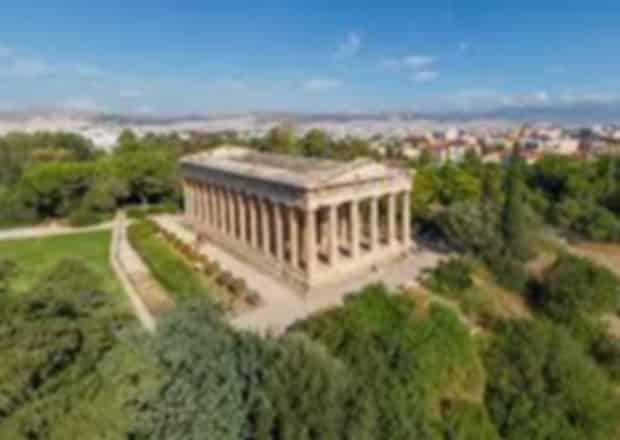
The Agora of Athens is one of the most significant archaeological sites in Greece. The Ancient Agora of Athens served as the city’s main public space for political debate, commercial activity, social gatherings and religious ceremonies. Located northwest of the Acropolis and easily accessible from the city centre, this UNESCO World Heritage site offers visitors an authentic glimpse into classical Greek civilisation. This guide on the Ancient Agora in Athens provides everything, from ticket prices and opening hours to insider tips for a smooth visit.
What Is the Ancient Agora of Athens?
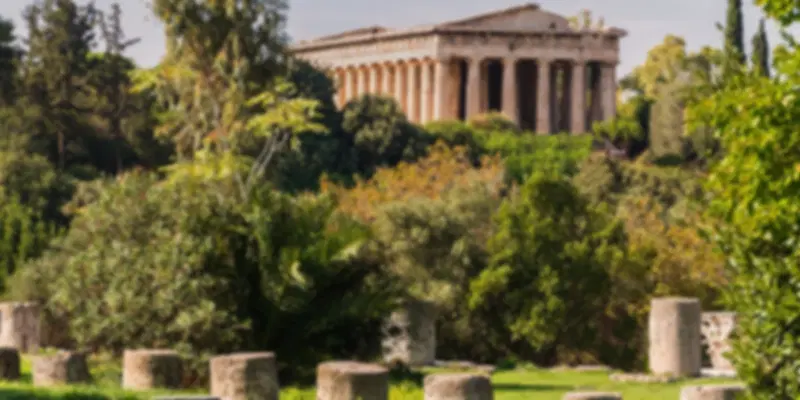
Ancient Agora of Athens archaeological site with the Temple of Hephaestus and Acropolis views
The Ancient Agora of Athens served as the commercial, political and social centre. The word “agora” translates to “gathering place” in Greek, and this 30-acre site fulfilled that purpose in every sense.
Historical Significance of the Ancient Agora of Athens
Democracy took shape here through daily practice. 500 citizens were selected by lottery to govern Athens, while magistrates worked around the clock in the Tholos.
This wasn’t merely an administrative district but the living, breathing core of Athenian identity. The markets were filled with stalls selling pottery, textiles and imported goods, while Temples honoured gods like Hephaestus and Apollo.
Top Attractions in the Ancient Agora of Athens
Reconstructed Stoa of Attalos in the Ancient Agora of Athens
Temple of Hephaestus – Greece’s Best-Preserved Ancient Temple
The Temple of Hephaestus crowns the western edge of the Agora, locally known as the Theseum. Built between 449 and 415 BCE, this Doric temple rivals the Parthenon in architectural beauty while surpassing it in preservation.
The temple honoured Hephaestus, god of metalworking and craftsmen, along with Athena. All 34 columns still stand proud, remarkably intact after 2,500 years.
Stoa of Attalos – Ancient Marketplace and Cultural Hub
The Stoa of Attalos dominates the eastern boundary of the Agora with its distinctive two-story colonnade. Originally built between 159 and 138 BCE by King Attalos II of Pergamon, this covered walkway served as an ancient shopping mall, where merchants sold everything from pottery to jewellery to imported luxuries.
Museum of the Ancient Agora – Artefacts from Democracy’s Birthplace
The reconstructed Stoa of Attalos now houses the Museum of the Ancient Agora, displaying artefacts excavated from the site. The collection spans 5,000 years of habitation, from Neolithic tools to Byzantine pottery.
One of the museum’s most powerful exhibits features ostraka, pottery fragments used in the voting process to exile controversial citizens. Other highlights include marble sculptures of gods and heroes, bronze coins minted on-site, everyday objects like lamps and cooking vessels and architectural fragments from destroyed buildings.
The Tholos and Bouleuterion – Government Buildings of Ancient Athens
The Tholos is a circular building that served as the executive headquarters of Athens. Fifty prytaneis, or council executives, worked here in rotating shifts. The building contained the city’s sacred fire, symbolising the city’s eternal spirit.
The Bouleuterion served as the meeting place for the Boule, a council of 500 citizens selected by lottery to serve one-year terms. This body prepared legislation for the Assembly and oversaw daily government operations.
Other Important Ruins in the Ancient Agora
Altar of the Twelve Gods – The Centre Point of Ancient Athens
The Altar of the Twelve Gods served as the literal centre point of Athens. All distances from the city were measured from this spot, making it ancient Athens’ equivalent of “mile zero”.
Stoa Poikile (Painted Stoa) – Birthplace of Stoic Philosophy
Though only foundations survive, this colonnade gave its name to Stoic philosophy after Zeno of Citium taught here. Interpretive signs mark the location where this influential philosophical school originated.
Temple of Apollo Patroos – Sanctuary of Athens’ Ancestral God
Fragments remain of this 4th-century BCE temple honouring Apollo as the ancestral god of Athens. The site museum displays a colossal statue of Apollo from this temple.
Visiting the Ancient Agora of Athens: Tickets and Practical Information
- Entry tickets cost Rs. 1,060 (10 euros) for adults, with discounted rates for seniors and students. Children under 5 and EU citizens under 25 enter for free.
- Consider purchasing a combination ticket for Rs. 3,200 (30 euros), which includes admission to the Acropolis, both Agoras, Temple of Olympian Zeus, Kerameikos, Hadrian’s Library and Aristotle’s School.
- The closest metro stations are Thissio on the Green Line and Monastiraki on both Green and Blue Lines, both within a five-minute walk. Numerous bus routes stop at Monastiraki.
Best Time to Visit the Ancient Agora of Athens
- Early morning visits between 8:00 and 9:00 AM offer the best experience. Temperatures remain comfortable, crowds are minimal, and soft morning light creates beautiful photography conditions.
- Wear comfortable, sturdy shoes. Light, breathable clothing is essential during summer when temperatures can exceed 35°C (95°F). Bring sunscreen, a hat and drink plenty of water, as shade is limited across the open archaeological park.
- Plan to spend at least 2 to 3 hours for exploration. This allows time to visit the Temple of Hephaestus and tour the museum.
- Combine your Agora visit with nearby attractions. The Roman Agora and Hadrian’s Library sit just a short walk away. The vibrant Monastiraki neighbourhood offers restaurants, cafes and shops perfect for lunch after your historical explorations. The Plaka district, Athens’ oldest neighbourhood, provides atmospheric streets for evening wandering.
Conclusion: Why the Ancient Agora in Athens Is Worth Visiting?
The Ancient Agora of Athens stands as one of the most significant archaeological sites in the world. While the Acropolis commands attention with iconic temples, the Agora reveals how ordinary Athenians actually lived, governed, and thought. From the perfectly preserved Temple of Hephaestus to the reconstructed Stoa of Attalos, from the scattered foundations of government buildings to the museum’s priceless artefacts, the Agora in Athens offers an unparalleled window into ancient Athens. Plan your visit ot this timeless historical destination with Pickyourtrail’s Athens Tour Packages or discover our Greece vacation packages that bring history to life with expertly curated itineraries.
Frequently Asked Questions about the Ancient Agora of Athens
Is the Ancient Agora worth visiting?
Yes, absolutely. The Ancient Agora offers one of the most authentic experiences of ancient Athens. Unlike the crowded Acropolis, it provides spacious grounds to explore at your own pace, with the Temple of Hephaestus being one of the best-preserved Greek temples in existence. History enthusiasts find it invaluable for understanding how democracy functioned in practice.
How long does it take to visit the Ancient Agora?
Most visitors spend two to three hours exploring the site thoroughly, including the Temple of Hephaestus, Stoa of Attalos, and the museum. If you’re pressed for time, you can cover the highlights in about 90 minutes, but the Agora rewards slower, more contemplative visits.
What is the difference between the Ancient Agora and the Roman Agora?
The Ancient Agora, also called the Greek Agora, is much larger and served as Athens’ main political, commercial, and social centre from the 6th century BCE. The Roman Agora was built later in the 1st century BCE during Roman rule, primarily as a commercial marketplace. They require separate tickets and are located near each other, but are distinct archaeological sites.
Can you visit the Agora without buying a ticket?
While you can glimpse some ruins from the surrounding streets, particularly the Temple of Hephaestus from Adrianou Street, you cannot properly experience the site without entering. The combination ticket covering multiple Athens sites offers better value than individual admission if you’re visiting several archaeological areas.
Was Socrates really at the Ancient Agora?
Yes, historical accounts from Plato, Xenophon, and other sources confirm Socrates spent his days in the Agora engaging Athenians in philosophical dialogue. He was ultimately tried, convicted, and executed for corrupting the youth and impiety, charges stemming from his public questioning in this very location. The Agora was central to his philosophical mission of examining life and challenging assumptions.
Is the Ancient Agora crowded?
The Agora typically has far fewer visitors than the Acropolis. Early morning and late afternoon visits offer the most peaceful experience. Even during peak season, the site’s large area means you can find quiet spots for reflection. Many travellers note the Agora as a welcome respite from Athens’ more touristy locations.
What should you not miss at the Ancient Agora?
Don’t miss the Temple of Hephaestus, Greece’s best-preserved ancient temple; the Museum of the Ancient Agora inside the Stoa of Attalos, particularly the ostraka voting shards; the view of the Acropolis from the Agora’s grounds; and simply walking the Panathenaic Way where ancient processions once passed. Allow time to sit and absorb the historical significance of where you’re standing.

Recommended articles for you








Discover Packages




















Need help in planning?
Talk to our Travel Experts