
Skydiving in New Zealand 2026: Complete Guide to Scenic Skydiving, Prices & Best Locations
Standing at 15,000 feet above snow-covered peaks and electric-blue lakes, the aircraft door slides open and the world suddenly feels vast, silent, and unreal. Then you jump. Skydiving in New Zealand is not just about adrenaline; it’s about falling past glaciers, volcanoes, alpine lakes, and dramatic coastlines in one of the most visually stunning countries on Earth. Whether you’re leaping over Queenstown’s mountains or Taupō’s volcanic landscapes, every jump delivers scenery that feels cinematic.
This complete 2026 guide covers the best locations, updated prices (from rates), safety rules, altitude comparisons, and how to choose the right island for your experience.
Is Skydiving in New Zealand Worth It?
Yes, it is completely worth it, especially if you care about scenery. Unlike many countries where skydiving views are flat farmland or coastline only, New Zealand offers:
- Snow-capped mountains
- Glacial lakes
- Active volcanic terrain
- Fjords and beaches
- Alpine valleys
It’s widely considered one of the most scenic skydiving destinations in the world, and for many travellers, it becomes the highlight of their New Zealand trip.
Also Read:- Best Indian Restaurants in new Zealand
Which New Zealand Island Is Better for Skydiving – North or South?
South Island – Best for Dramatic Alpine Views
- Queenstown
- Wānaka
- Franz Josef
- Aoraki / Mount Cook (Twizel/Pukaki region)
- Abel Tasman
Expect glaciers, mountains, and turquoise lakes.
North Island – Best for Volcanic Landscapes
- Taupō
- Bay of Islands
Expect volcanic craters, rolling hills, and coastal panoramas.
To summarise, if you want jaw-dropping mountain scenery, choose the South Island. If you want volcanic drama and easier access from Auckland, choose the North Island.
Also Read:- Beautiful Towns in New Zealand
Types of Skydiving in New Zealand
Tandem Skydiving (Most Popular)
Perfect for first-timers. You are securely harnessed to a certified instructor.
- Freefall: 50–70 seconds
- Height: 12,000–16,500 ft
- Prices: From NZD 399–899 (INR 20,000–45,000 approx., depending on height & location)
Operators include:
- NZONE Skydive (Queenstown)
- Skydive Wānaka
- Skydive Franz
- Skydive Taupō
Accelerated Freefall (AFF Training)
For those pursuing a skydiving licence.
- Starts from NZD 899+ (INR 45,000+ approx.)
- Multiple supervised jumps
- Teaches canopy control & solo exit techniques
Solo Skydiving (Licensed Jumpers)
Available at major drop zones with verified credentials.
Best Skydiving in New Zealand
Skydiving sports in new zealand
1. Queenstown – The Most Famous
Queenstown delivers full alpine drama from mountains to Lake Wakatipu and rugged terrain.
Operator: NZONE Skydive
- Height: Up to 15,000 ft
- Price: From NZD 450–600 (INR 23,000–30,000 approx.)
- Best Season: October–April
Queenstown delivers full alpine drama from mountains to Lake Wakatipu and rugged terrain.
Best for: First-timers who want iconic scenery.
2. Wānaka – Scenic & Less Crowded
Lake Wānaka’s turquoise water, paired with a snowy peak,s makes this highly photogenic.
Operator: Skydive Wānaka
- Height: Up to 15,000 ft
- Price: From NZD 429–579(INR 23,100–31,600 approx)
- Best Season: November–March
3. Franz Josef – Glacier Views
Operator: Skydive Franz
- Height: Up to 16,500 ft*
- Price: From NZD 599(INR 32,600 approx)
*16,500 ft jumps depend on weather and aircraft availability.
This jump offers one of NZ’s longest freefalls and views of glaciers meeting rainforest.
4. Aoraki / Mount Cook Region (Twizel & Lake Pukaki)
Important clarification: Skydiving is not directly at Mount Cook summit, but near Twizel / Lake Pukaki, with clear views of Aoraki.
- Height: Up to 16,500 ft
- Price: From NZD 599–899(INR 32,600 – 49,400 approx)
Best for: Glacier-lake contrasts and Mount Cook backdrop.
5. Taupō – Best North Island Option
Operator: Skydive Taupō
- Height: Up to 15,000 ft
- Price: From NZD 399–649(INR 21,837–35,520 approx)
Jump above Lake Taupō and the Tongariro volcanic landscapes.
Best for: Auckland travellers and volcanic scenery lovers.
Altitude Comparison Table
| Location | Max Height | Freefall Time | Landscape Type | Best For |
| Queenstown | 15,000 ft | ~60 sec | Alpine lakes & mountains | First-timers |
| Wānaka | 15,000 ft | ~60 sec | Scenic lake + peaks | Photographers |
| Franz Josef | 16,500 ft* | ~70 sec | Glacier + rainforest | Longest freefall |
| Mount Cook Region | 16,500 ft | ~70 sec | Glacier lakes | Dramatic scenery |
| Taupō | 15,000 ft | ~60 sec | Volcanic + lake | North Island |
*Weather dependent.
Which Location Is Best for Beginners?
Best overall for beginners:
- Queenstown
- Taupō
- Wānaka
Reasons:
- Large, established operators
- Frequent departures
- Smooth landing zones
- Strong safety track record
Safety & Regulation in New Zealand
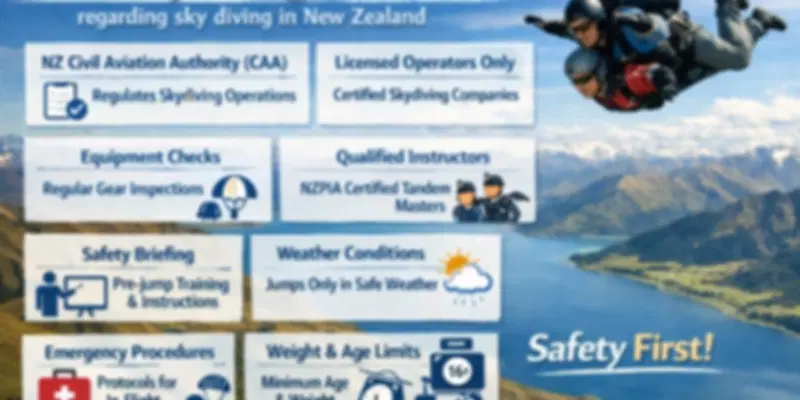
Rules and regulation for sky diviing in new zealand
All commercial operators in NZ are regulated by the Civil Aviation Authority (CAA).
Additional safety details:
- Tandem instructors are certified and highly experienced
- Every jump uses a primary and a reserve parachute
- Automatic Activation Devices (AAD) deploy a reserve if needed
- Oxygen systems are used for high-altitude 16,500 ft jumps
- Weather grounding policies are strict
New Zealand maintains one of the strongest skydiving safety records globally.
Also Read:- Bollywood Movie Shoots in New Zealand
Best Time to Skydive
- October–April: Best visibility and weather
- May–September: Possible, but more weather holds in alpine areas
Allow 2–5 hours on jump day for briefing and weather checks.
Updated 2026 Pricing Guide (From Rates)*
| Jump Type | Height | Price From (NZD) | Approx INR |
| Tandem Basic | 12,000 ft | 399 | ₹20,000 |
| Tandem Standard | 15,000 ft | 450–600 | ₹23,000–30,000 |
| Premium | 16,500 ft | 599–899 | ₹30,000–45,000 |
| AFF Course | Multi-jump | 899+ | ₹45,000+ |
*Prices vary by season, media packages, and peak months.
Final Thoughts
Skydiving in New Zealand is not just about jumping out of a plane; it’s about falling through some of the most extraordinary landscapes on Earth. Whether you choose Queenstown’s alpine drama, Taupō’s volcanic vastness, or Mount Cook’s glacier lakes, this is an experience that redefines adventure travel.
If you’re planning a New Zealand itinerary, adding one jump can turn a scenic holiday into a once-in-a-lifetime story.
FAQs
Yes. All commercial operators are regulated by the Civil Aviation Authority (CAA) of New Zealand, and tandem jumps are conducted with certified instructors using dual parachute systems and Automatic Activation Devices (AAD).
Most operators allow skydiving from 16 years old, with parental consent required for anyone under 18.
Yes. The typical weight limit ranges between 90 kg and 110 kg, depending on operator policies, weather conditions, and safety harness limits.
Queenstown and the Mount Cook (Twizel/Lake Pukaki) region are widely considered the most scenic due to alpine mountains, glacier lakes, and dramatic landscapes.
The South Island is better for dramatic alpine and glacier scenery, while the North Island is ideal for volcanic landscapes and easier access from Auckland.
Although the freefall lasts 50–70 seconds, you should allow 2–5 hours for safety briefings, gear fitting, weather checks, and aircraft boarding.

Recommended articles for you






Discover Packages
















Need help in planning?
Talk to our Travel Experts