
9 Most Beautiful Cities in Europe to Add to Your Bucket List in 2026

Exploring the beautiful cities in Europe is a dream for travellers seeking timeless art, breathtaking landscapes, and rich historical wonders. From the romance-filled cobblestone streets of Paris to the stunning alpine backdrops of Switzerland, this continent offers an unforgettable escape for every travel style.
To make your dream trip seamless, selecting the right curated Europe tour packages is the easiest way to experience the iconic sights, local cultures, and hidden gems with absolute peace of mind. This blog helps Indian travellers choose European cities that are not just visually stunning but also truly worth your time, budget, and overall travel experience.
Also read: Cheapest European Cities
Quick Key Takeaways
- Best overall city: Paris for grandeur; Prague for budget; Lisbon for value + beauty
- Best time to visit: April–June & September–October (avoid peak July–August heat and crowds)
- Visa required: Schengen visa for most European cities — fee is €80 (~₹9,000) per adult
- Average trip cost from India: ₹1.5–2.5 lakh for 10 days (flights + stay + food + sightseeing)
- Cheapest beautiful cities: Prague, Budapest, Porto, Kraków, Dubrovnik
- Most underrated pick: Porto, Portugal, all of Venice’s charm at half the price
- Indian food availability: Excellent in Amsterdam, Paris; moderate elsewhere
The 8 Most Beautiful Cities in Europe
Paris, France

The view of one of the most beautiful cities in Europe, Paris
No list of the most beautiful cities in Europe can begin anywhere else. Paris has been ranked the world’s most attractive city destination for four consecutive years by Euromonitor International, and it is not difficult to see why. The city feels designed to be beautiful: Haussmann’s wide boulevards, the golden curve of the Seine, and the Eiffel Tower appearing without warning between buildings. It never gets old.
- Top things to do: walk the banks of the Seine at golden hour, visit Sainte-Chapelle, explore the Marais district on foot, take the Metro to Montmartre, and eat a croque-monsieur at a proper zinc-bar café.
- Average cost: €120–€200 (₹12,000–₹20,000) per person/day
- Best time to visit: April–June and September–October
Insider tip: Most tourists queue for the Eiffel Tower. Locals go to the Trocadéro gardens opposite, free, perfect view, no queue. For Indian travellers, the area around Gare du Nord has several excellent South Indian restaurants.
Florence, Italy
Florence welcomes over 16 million visitors a year, and the Uffizi Galleries alone drew more than 5.2 million people in 2026. Those numbers exist because Florence is genuinely, almost unfairly, beautiful. The Duomo does not just appear in photographs; it physically stops you in the street. Additionally, the Arno River at dusk turns the colour of honey. There is nowhere else quite like it.
- Top things to do: Climb the Duomo’s dome for the city view, stroll across Ponte Vecchio at sunrise (before the crowds), visit Michelangelo’s David at the Accademia, and spend an afternoon in the Boboli Gardens.
- Average cost: €90–€150 (₹9,000–₹15,000) per person/day
- Best time to visit: April–June and September–October
Insider tip: Book all museums at least 3 weeks in advance, walk-in queues regularly stretch 2–3 hours. Stay in the Oltrarno neighbourhood for a quieter, more local experience. Pre-booked entry slots are non-negotiable in summer.
Venice, Italy
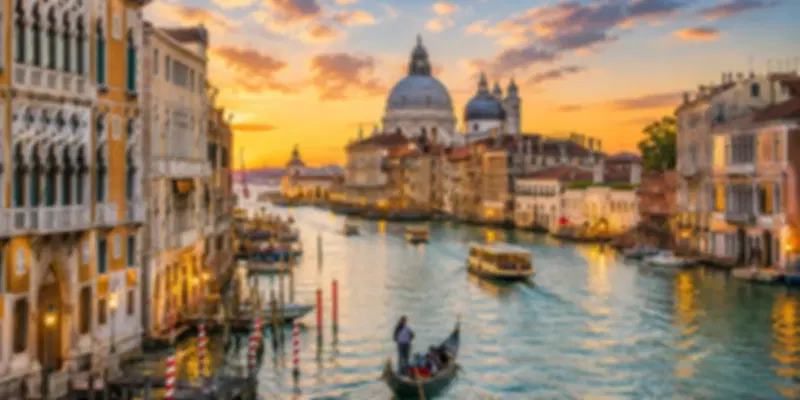
Glide through the canals of Venice; One of the most beautiful cities in Eriupe
Built across 118 islands connected by over 400 bridges, Venice is genuinely unlike any other place on earth. The absence of motor traffic, no honking, no exhaust, gives the city a strange, almost eerie tranquillity. Additionally, the reflections of pastel palaces in still canal water, the gondoliers calling to each other in dialect, and the complex mosaics of St. Mark’s Basilica – it is surreal in the best possible way.
- Top things to do: Take a vaporetto (water bus) down the Grand Canal, visit the Doge’s Palace, explore the islands of Murano (glass) and Burano (lace and colour), and get genuinely lost in the back alleys of Dorsoduro.
- Average cost: €100–€180 (₹10,000–₹18,000) per person/day
- Best time to visit: April–June and September–October
Insider tip: Visit in November or February for mist-wrapped canals, half the crowds, and a quarter of the price. In summer, the crowds are genuinely suffocating. The city now charges a day-entry fee (€5) for day-trippers; budget for this.
Prague, Czech Republic
Prague is one of Europe’s best-kept open secrets. Unlike Rome or Paris, it survived the 20th century largely intact, meaning its medieval and Baroque architecture is extraordinarily well-preserved. Walk across Charles Bridge at 6 am with the mist rising off the Vltava River and no one else around, and you will understand why Prague regularly tops “most beautiful city in Europe” polls.
- Top things to do: Explore Prague Castle (the largest ancient castle complex in the world), walk through Old Town Square to the Astronomical Clock, cross Charles Bridge at dawn, and spend an evening in a cosy wine bar in Malá Strana.
- Average cost: €60–€100 (₹6,000–₹10,000) per person/day
- Best time to visit: April–May and September–October
Insider tip: Prague is one of the cheapest European cities. A full meal costs ₹500–800. Accommodation is 40–50% cheaper than in Paris or Amsterdam. The Czech Republic is part of the Schengen Zone but still uses the Czech Koruna (CZK), not the Euro. Exchange in advance.
Santorini, Greece

Mesmerising view of Santorini
Santorini is essentially a volcanic caldera, shaped by a massive eruption, with its iconic cliffside villages like Oia and Fira cascading in white and blue over the Aegean. It feels almost unreal, like stepping into a perfectly painted landscape. And despite how often you’ve seen it online, Santorini is even more striking in person. The sunsets from Oia’s castle viewpoint aren’t just beautiful; they’re unforgettable, the kind that completely stills you in the moment.
- Top things to do: Watch the sunset from Oia, swim at the Red Beach and Perissa Black Sand Beach, take a boat tour of the caldera hot springs, and wine-taste at a cliffside winery in Pyrgos.
- Average cost: €120–€220 (₹12,000–₹22,000) per person/day
- Best time to visit: May–June and September–October
Insider tip: Book accommodation on the caldera-facing (western) cliff for sunset views; they’re pricier but worth every rupee.
Barcelona, Spain
Barcelona is the only city in the world where the architecture itself is the main attraction. Antoni Gaudí’s buildings, the Sagrada Família, Casa Batlló, and Park Güell, are so extraordinary that they reframe what architecture can be. Add to that sandy city beaches, a world-class food scene, and the electric energy of Las Ramblas, and you have one of Europe’s most complete cities.
- Top things to do: Visit the Sagrada Família (book tickets weeks in advance), explore Park Güell, walk the Gothic Quarter, attend an FC Barcelona match if the season aligns, and spend a morning at Barceloneta Beach.
- Average cost: €90–€160 (₹9,000–₹16,000) per person/day
- Best time to visit: April–June and September–October
Insider tip: Skip Las Ramblas for your evening stroll; it is heavily tourist-facing. Instead, walk through El Born neighbourhood for tapas bars and local atmosphere.
Amsterdam, Netherlands
View of the city of Amsterdam
Amsterdam’s beauty is intimate and human-scale in a way that grand capitals like Paris are not. The 17th-century canal ring, 165 canals, 1,281 bridges, is a UNESCO World Heritage Site. The gabled merchant houses lean at improbable angles, the houseboats are fully inhabited, and the city is designed for walking and cycling, not driving. It is effortlessly lovely.
- Top things to do: Rent a bicycle and cycle through Vondelpark and the Jordaan neighbourhood, visit the Anne Frank House (book months in advance), explore the Rijksmuseum and Van Gogh Museum, and take an evening canal cruise.
- Average cost: €120–€200 (₹12,000–₹20,000) per person/day
- Best time to visit: April–May and September–October
Insider tip: Amsterdam has one of Europe’s largest Indian communities, and the area around Spuistraat has several excellent Indian and Surinamese-Indian restaurants. Avoid the peak of tulip season in April if you want cheaper hotels.
Lisbon, Portugal
Lisbon, Europe’s westernmost capital, is also one of its best-value beautiful cities. Spread across seven hills and stitched together by its iconic yellow trams, the city opens out to the Atlantic with a quiet, understated charm. There’s a certain mood to Lisbon, melancholic yet warm, shaped by its light, its views, and its rhythm. You’ll hear it in Fado, the city’s hauntingly beautiful music of longing, drifting through streets and settling in slowly, much like Lisbon itself.
- Top things to do: Ride Tram 28 through the Alfama district, visit Belém Tower and the Jerónimos Monastery, eat a pastel de nata at Pastéis de Belém (the original, since 1837), walk to the Miradouro da Graça viewpoint at sunset, and day-trip to the palaces of Sintra.
- Average cost: €70–€120 (₹7,000–₹12,000) per person/day
- Best time to visit: March–May and September–October
Insider tip: Lisbon is one of the most affordable Western European capitals for Indian travellers, and daily costs are 30–40% lower than Paris or Amsterdam.
Porto, Portugal
Porto is a hidden gem in Europe
Porto is widely considered the ultimate hidden gem for budget-conscious travellers. In this striking coastal city, cascading terracotta rooftops tumble dramatically down the hillsides to meet the edge of the scenic Douro River. This entire destination radiates a romantic, canal-side charm that rivals Venice, but at roughly half the travel cost. Don’t miss exploring Ribeira, Porto’s vibrant riverside old town, which is officially recognised as a UNESCO World Heritage Site
- Top things to do: cross the Dom Luís I Bridge on foot, tour a port wine cellar in Vila Nova de Gaia, ride Tram 1 along the river, and browse Livraria Lello (one of the world’s most beautiful bookstores).
- Average cost: €60–€100 (₹6,000–₹10,000) per person/day
- Best time to visit: April–June and September–October
Insider tip: Porto is 30–40% cheaper than Lisbon on food and stays, and gets a fraction of the tourist volume — book a river-view guesthouse in Ribeira for the best value on this whole list.
Suggested 10-Day Europe Itinerary Covering the Beautiful Cities in Europe
This 10-Day Europe Itinerary combines some of the continent’s most beautiful cities with a balance of iconic landmarks, culture, food, and scenic experiences. It is designed to help Indian travellers cover the highlights without spending too much time in transit.
| Day | City | Highlights |
| Day 1 | Paris | Arrival, evening walk along the Seine, Eiffel Tower views from Trocadéro |
| Day 2 | Paris | Sainte-Chapelle, Montmartre, explore Le Marais, café hopping |
| Day 3 | Amsterdam | Train/flight to Amsterdam, canal cruise, evening in Jordaan |
| Day 4 | Amsterdam | Anne Frank House, Van Gogh Museum, cycling through Vondelpark |
| Day 5 | Prague | Fly to Prague, Old Town Square, Astronomical Clock, evening wine bar |
| Day 6 | Prague | Prague Castle, Charles Bridge at sunrise, Malá Strana exploration |
| Day 7 | Florence | Fly/train to Florence, Duomo visit, sunset at Piazzale Michelangelo |
| Day 8 | Venice | Day trip to Venice, Grand Canal vaporetto, St. Mark’s Basilica |
| Day 9 | Barcelona | Fly to Barcelona, Sagrada Família, Gothic Quarter walk |
| Day 10 | Santorini | Fly to Santorini, Oia sunset, caldera views |
Why This Itinerary Works
- Covers 7–8 iconic cities without feeling rushed
- Smart routing using short-haul flights + trains
- Balances culture (Paris, Prague), architecture (Barcelona), romance (Venice), and landscapes (Santorini)
- Designed keeping Schengen visa efficiency & Indian travel patterns in mind
Essential Tips for Exploring Beautiful Cities in Europe
Exploring the beautiful Cities in Europe requires smart logistics, efficient routing, and a clear budget strategy to ensure a hassle-free vacation. With new border policies, shifts in exchange rates, and ticket inflation, navigating your holiday smoothly requires modern planning tactics.
- Open-Jaw Routing: Book your flights entering one European city and departing from another to eliminate unnecessary backtracking.
- 3-4 Month Window: Lock in your primary flight bookings across transcontinental or regional paths at least 90 to 120 days out to save up to ₹25,000.
- Mid-Week Departures: Schedule your long-haul departures for a Tuesday or Wednesday to avoid premium weekend pricing.
- FlixBus Over Trains: Opt for cross-border bus options like the FlixBus App for long-distance transport, which often runs five times cheaper than rail tickets.
- Early Rail Lock-Ins: Secure high-speed intercity train journeys 3 to 4 months in advance before seasonal prices spike sharply.
- Pack Light & Roll: Bring only one sturdy wheeled carry-on bag to easily navigate steep, historic cobblestone streets without injuring your back.
- Advanced Slot Booking: Purchase your entries for major sites like Florence’s Duomo or Barcelona’s Sagrada Família online at least 3 weeks ahead.
- Tipping-Based Walking Tours: Utilize local, tip-based free walking city tours on your first morning to pinpoint geographic layouts without spending much.
- Schengen Visa Tracking: Apply for your Schengen Visa at least one full month before flying, focusing your primary stay in lenient processing nations.
Final Thoughts: Which Beautiful European City Should You Visit?
Exploring the beautiful cities in Europe offers an unmatched mix of deep history, timeless architecture, and diverse cultures. The best European city to visit depends on your travel style and budget. Choose Paris for iconic landmarks, Florence and Venice for romance and history. Visit Prague and Porto for affordable beauty, Santorini for a scenic escape, and Barcelona for architecture, beaches, and nightlife. For a first Europe trip, combining 4–6 cities offers a better balance than rushing through too many destinations.
Ready to turn your Europe wishlist into a real holiday? If you’re looking for something more romantic and experience-driven, a curated Europe honeymoon package covering Venice and Santorini adds that once-in-a-lifetime element.
FAQs: Most Beautiful Cities in Europe
1. Which are the most beautiful cities in Europe for first-time travellers?
Cities like Paris, Amsterdam, and Prague are ideal for first-time travellers due to their accessibility, iconic attractions, and well-connected transport.
They offer a perfect mix of culture, sightseeing, and ease of travel for Indian tourists.
2. What is the best time to visit the most beautiful cities in Europe?
The best time is April–June and September–October when the weather is pleasant and crowds are manageable.
Avoid July–August if you prefer fewer crowds and better hotel prices.
3. How much does a Europe trip cost from India?
A 10-day Europe trip typically costs ₹1.5–2.5 lakh per person, including flights, hotels, food, and sightseeing.
Costs can increase depending on cities, travel style, and season.
4. Which cities are best for a Europe honeymoon package?
Venice, Santorini, and Paris are among the best choices for a Europe honeymoon package.
They offer romantic views, unique experiences, and memorable stays.
5. Is a Schengen visa required for visiting these cities?
Yes, most of the most beautiful cities in Europe fall under the Schengen Zone.
A single Schengen visa allows you to travel across multiple countries for up to 90 days.
6. How many cities should you cover in a 10-day Europe trip?
Ideally, 4–6 cities are manageable in 10 days without rushing your experience.
Prioritise nearby destinations and use trains or short flights for efficient travel.
7. What is the most beautiful city in Europe to visit?
Paris is a top choice for its iconic landmarks, grand architecture, and romantic atmosphere. Prague, Florence, Venice, and Santorini are also excellent choices for their unique beauty and experiences.
8. Which European cities are the most beautiful and affordable?
Prague, Porto, Lisbon, and Florence offer a great mix of beauty and affordability. Porto and Prague are particularly budget-friendly compared with cities like Paris and Amsterdam.
9. What are the best cities in Europe for couples and honeymooners?
Venice, Santorini, and Paris are ideal for couples and honeymooners. They offer romantic views, beautiful architecture, sunset experiences, and memorable stays.
10. Which are the most beautiful cities in Europe to visit in summer?
Paris, Amsterdam, Florence, Barcelona, and Santorini are great summer choices. For pleasant weather and fewer crowds, consider May–June instead of the peak July–August period.
11. Which European cities are best for architecture, history and culture?
Florence, Prague, Paris, Venice, and Barcelona stand out for architecture, history, and culture. They offer everything from medieval streets and historic palaces to Renaissance art and Gaudí’s architecture.
12. What are the best European cities to visit on a budget?
Prague and Porto are among the best options for budget-conscious travellers. Lisbon and Florence also offer good value, with lower daily costs than cities such as Paris and Amsterdam

Recommended articles for you










Discover Packages



















Europe City Packages
Packages By Departure City
Packages By Theme
Packages By Duration
Europe Combo Packages
Europe Nearby Destinations

Need help in planning?
Talk to our Travel Experts